Aug 2024 – Apr 2025
Daily Revenue
Month-on-Month Retention
Daily Active Users
Rummy is not a game users casually “figure out” in one session.
For skilled players, it is strategy, speed, memory, and money movement. For new players, it can feel overwhelming.
As the Lead Product Designer, my goal was not just to design another table, but to shape Tez Rummy as a complete product experience — helping users enter confidently, learn faster, understand outcomes, and return to play again.
Overview
The game was familiar. The product journey was not — When we started building Tez Rummy, the market was already crowded — with users shaped by platforms like Junglee Rummy, RummyCircle, and Rummy Culture.
We were entering a category where benchmarks already existed — familiar tables, rewards, tournaments, withdrawals, and loyalty hooks.
The challenge was to design Tez Rummy beyond screens: credible from day one, easier for new users, and polished enough for experienced players.
The Problem
Before designing Tez Rummy, the biggest question was not “what screens should we build?”
It was “what could stop users from understanding, trusting, and returning to a new real-money Rummy product?”
Early research revealed three product risks:

Learning Friction
Users can read the cards, but struggled to decide the right move.

First-Play Hesitation
Early mistakes or losses could quickly reduce confidence.

Experienced Player Benchmark
Users can read the cards, but struggle to decide the right move.
The core problem was not just gameplay. — It was designing user confidence across every critical moment of the journey.
The goal was clear:
Make Tez Rummy easier to start,
cleaner to play & Rewarding enough to return to
Setting the Foundation
Before designing screens, we studied the category deeply.
To shape Tez Rummy, we first needed to understand how different users approached the game — not just what they played, but why they trusted one platform, avoided another, or dropped off when the rules felt unclear.


We studied regular Rummy players, users familiar with card games but not Rummy deeply, and power users who compared every platform through speed, rewards, trust, and money movement.
This helped us define Tez Rummy around three core experience pillars: trust, clarity, and repeat engagement.
What Research Revealed
From user and competitive research, a few strong patterns kept showing up across different player types:
Player Archetypes
Research helped us identify four player mindsets
Before shaping the journey, we grouped users by their level of game understanding, confidence, and reward motivation — not by generic demographics.






These archetypes helped us shape the journey around different confidence levels.
Learn, trust, play fast, and return.
Designing the Confidence Ladder
Turning research into a product path
The research gave us one strong direction: users didn’t need everything upfront.
They needed confidence to build gradually — one step, one decision, one outcome at a time.
Discover
Create interest without
overwhelming the user.


Enter
Help them start with the
right first game.
Understand
Make rules and actions
easier to read.
Play
Support confident moves
during the game.
Recover
Make early loss feel less
discouraging.
Return
Give users a reason to
come back.
The idea was simple:
don’t ask users to trust the product all at once — earn it step by step.
Product Vision
Converting the ladder into product bets
Once the confidence path was defined, the next question was sharper:
Guided Entry
Gameplay Clarity
Value & Recovery
Scalable Format
The vision was to build Tez Rummy as a product that could
Designing the Core Experience
Once the vision was defined, the next step was to turn it into the actual product experience. Each layer had one clear job — help users start, choose, play, understand, recover, or come back.
Entry to First Game
Make the first step feel obvious
The first interaction had to reduce doubt and give users a clear starting point.
What changed in the experience:
Users were guided toward a simpler first game instead of being pushed into a full lobby immediately.

Lobby Discovery
Help users choose without overthinking
The lobby needed to work for two behaviours — new users looking for direction and skilled players looking for control.
What changed in the experience:
Tournament discovery became more guided, with clearer entry points, visible value, and progressive exposure.

Gameplay Table
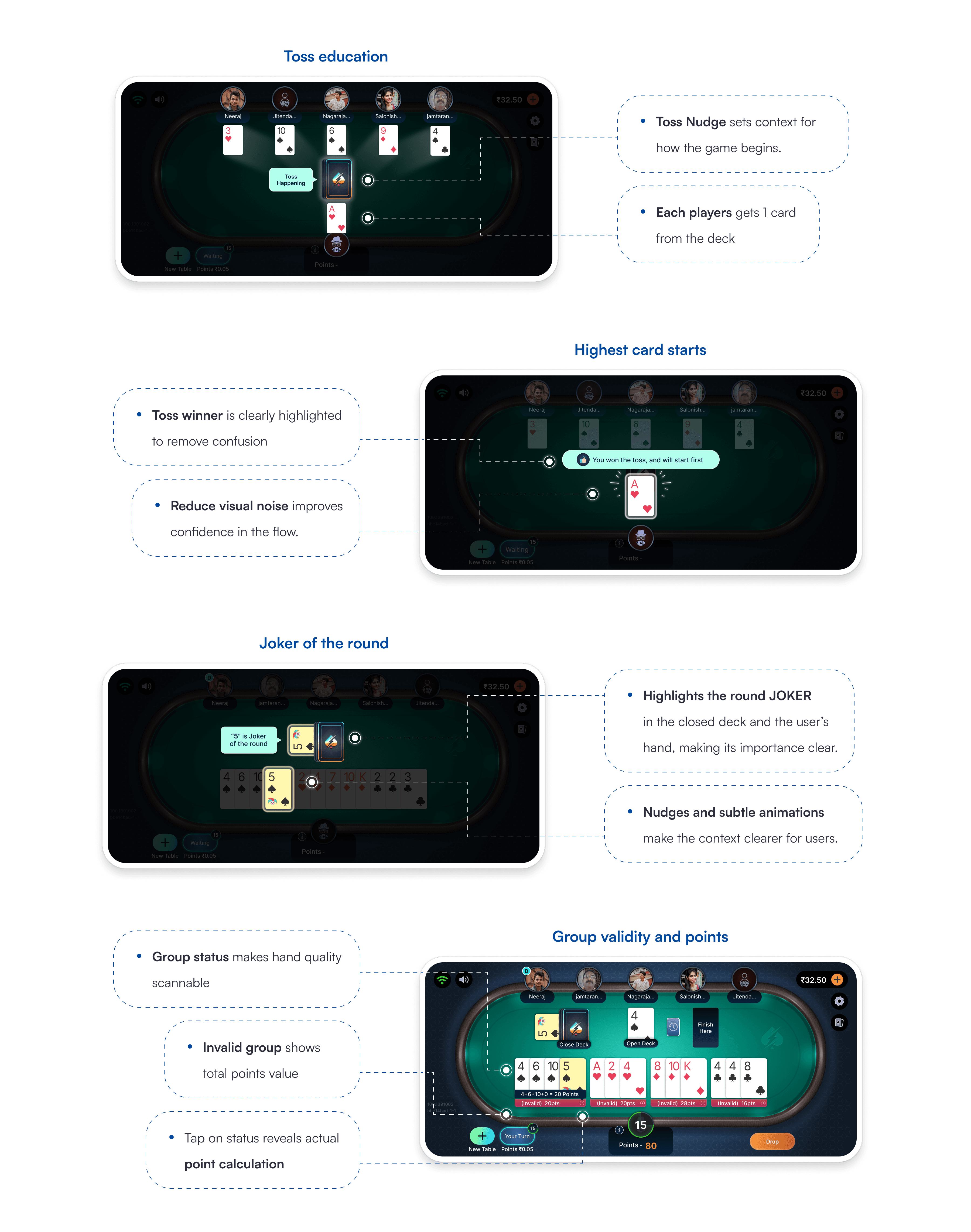
Make the table do the teaching
The table had to stay fast, but still help users understand what to do next.
What changed in the experience:
Critical actions became more readable through clearer states, visual cues, and improved table feedback.
Declaration Flow
Add confidence before commitment
Declaration was a high-stakes moment, so the flow needed to slow users down just enough to prevent accidental mistakes.
What changed in the experience:
Users got confirmation, rearrangement support, and clearer consequences before submitting.

Result / WD Screen
Explain the outcome, then guide the next step
The end of a game had to answer two questions quickly: What happened? and What should I do next?
What changed in the experience:
The result screen became a learning and continuation moment, not just a closure state.

Interactive Education
Let users learn by doing
Research showed that passive learning would not be enough. The education layer had to make users practise the actions themselves.
What changed in the experience:
Learning became smaller, contextual, and action-led — easier to complete and easier to remember.

Rewards & Retention
Turn value into a reason to return
Rewards had to feel visible and useful at the right moment — especially after early loss or session drop-off.
What changed in the experience:
Rewards moved from being passive wallet entries to active comeback triggers.


Format Expansion
Build patterns that could scale
The product needed room to grow beyond the first gameplay format without making every new format feel unfamiliar.
What changed in the experience:
Reusable patterns helped extend the product into deeper Rummy formats while keeping score, money, and support flows understandable.

Product performance after launch
Design contribution: guided entry, gameplay clarity, rewards, recovery and scalable patterns helped support these outcomes.
Key outcomes




Phased rollout story
1
2
3
4
Phase 01
Build the core
We first focused on creating the complete foundation of the product — signup, lobby, Points Rummy, gameplay table, declaration, and result flow.
Phase 02
Improve first-game confidence
Once the core was live, the next focus was to reduce hesitation for new users through FTCP nudges, recommended tournaments, guided lobby, and clearer gameplay actions.
Phase 03
Build retention systems
After improving first-game confidence, we introduced return hooks such as scratch cards, bonus, loss recovery, Tez Coins, missions, and new-user tasks.
Phase 04
Scale the ecosystem
Finally, the product expanded with Deal, Pool, scoreboards, support flows, compliance journeys, and configurable experiments to support future growth.
Closing Thought
Tez Rummy wasn’t designed as just another card table — it was shaped as a complete product ecosystem where every interaction had to build user confidence, money clarity, learning, and repeat-play motivation. The biggest design shift was thinking beyond screens and designing the full journey of trust, learning, money clarity, and return motivation.
“We didn’t redesign Rummy. We designed a new path for users to understand it, trust it, play it, and return to it.”